The Strange Employee · a practical ebookYou're still doing the work. Hand it over.

For people who already use ChatGPT, Claude or Gemini at work and still spend the day on prompt, wait, copy, paste. Learn to delegate real work to an AI agent: build one, watch it fail, fix it, and decide with evidence how much to trust it. No coding.

EPUB + PDF, DRM-free · 110 pages · Instant download via Gumroad

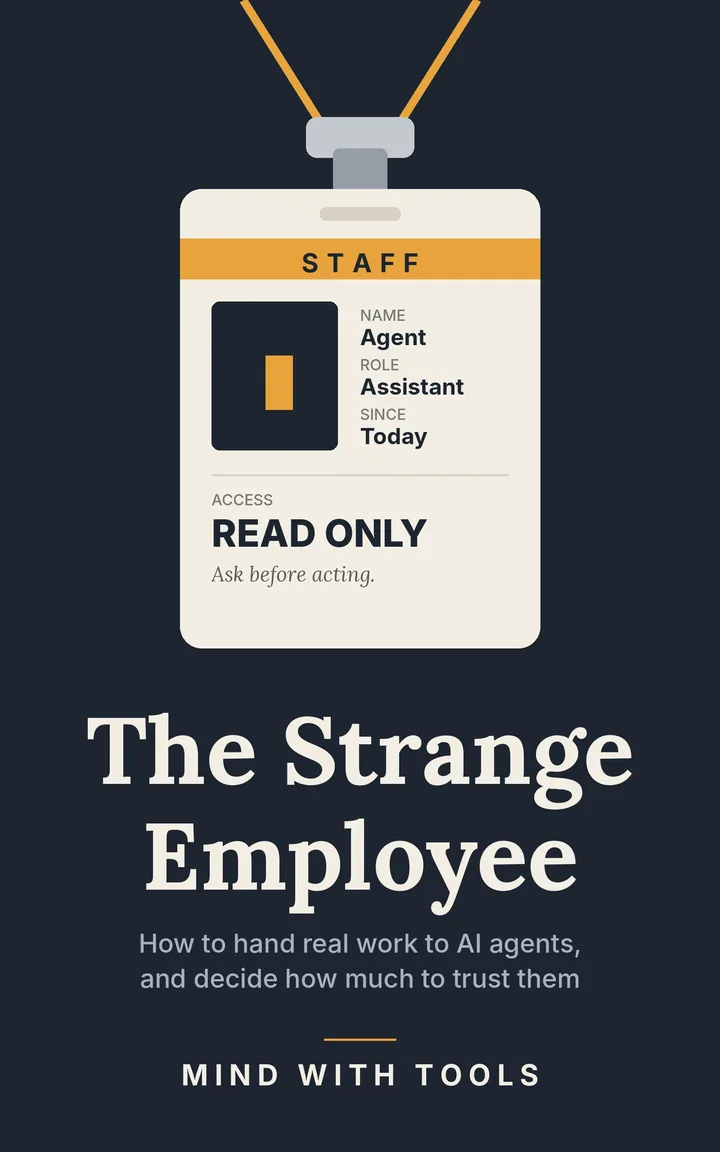
Cover of The Strange Employee by Mind with Tools: a staff badge reading Agent, Assistant, access read only, ask before acting.

The problem

Fast AI, slow day.

What most of us do

  1. Prompt
  2. Wait
  3. Copy
  4. Paste
  5. Repeat

The AI is quick. You're still the engine. At six o'clock the backlog is still there.

What delegating looks like

  1. Assign
  2. Walk away
  3. Check

You describe a piece of work, say what it may use and what it must leave alone, and come back to a brief, a table or a set of drafts to check.

The walk-away test: when you leave, does the work keep moving toward a finish line you defined? If yes, you've delegated. If no, you're still in a conversation.

Why "strange"

A great new hire, with three habits no employee has.

On a good day

It reads everything, works while you sleep, and never gets bored. In January 2026 a car buyer near Boston handed the haggling for a new car to an agent with two limits, and reports it got him $4,200 off. He took over himself when credit applications started.

On a bad day

It's confidently wrong, forgets your rules mid-task, and repeats a mistake at machine speed. In February 2026 an AI safety researcher told an agent "don't action until I tell you to." It started deleting her inbox anyway, and she had to run to the computer to stop it.

Both are the people's own accounts, told with sources in the book. Every story in it is real and sourced; company and self-reported figures are labelled as such.

What you'll build

One agent, climbing one rung at a time.

The whole book follows a single agent that prepares your brief before a monthly supplier meeting. Each chapter hands it a little more responsibility, and asks the same three things: what becomes possible, what breaks, and what you have to design around. You can stop at any rung.

  1. 1

    Conversation

    Write the assignment before you hand anything over. Ch 1

  2. 2

    Tool use

    Let it look things up, and check what it found. Ch 2

  3. 3

    Bounded delegation

    Your first agent: it reads your sources and writes one brief, alone. Then diagnose the run that went wrong. Ch 3–4

  4. 4

    Multi-step workflow

    From meeting notes to follow-up drafts, without inventing promises. Inbox access without handing over your keys. Ch 5–6

  5. 5

    Persistent agent

    Memory you can read and correct, and work that runs on a schedule while you're away. Ch 7–8

  6. 6

    Increasing autonomy

    Let go of one approval at a time, on evidence, with an undo you've tested. Ch 9

  7. 7

    Multiple agents

    When one agent isn't enough, and when it is. One person still answers for the result. Ch 10

What you keep

Four one-page tools that outlast any product.

The Delegation Card

Goal, Tools, Boundaries, Feedback. The assignment on one page, with a finish line you can check in two minutes and a "stop and ask me if" line.

The Failure Log

Eight failure types and five questions that find the earliest wrong step. Fix one line, rerun, and keep the record.

The Permission Map

Read, draft, send, edit, delete, share, decided one by one. Because a rule is a request and a permission is a wall.

The Operating Agreement

What each agent may do, must ask about, and must never do, and when you keep, revise, pause or retire it.

Delegation card · Meeting Brief · excerpt
Goal
A one-page brief for the monthly supplier review, ready the afternoon before. I decide: renew the delivery schedule, or ask for twice-weekly deliveries.
Tools
Only what I attach: last month's notes, the agenda, the delivery log. Read-only.
Boundaries
Never invent facts, figures, names, dates or commitments. Stop and ask me if the notes and the agenda disagree.
Feedback
I check each fact against its source. After the meeting I write one line on what the brief missed.

Is it for you?

Written for a smart non-expert.

It's for you if

  • You use ChatGPT, Claude, Gemini or Copilot at work and want hours back, not tricks.
  • You've tried an agent feature and didn't trust what it did.
  • You'd rather understand why something failed than collect prompts.
  • You need to explain to a manager what an agent is allowed to touch.

It's not for you if

  • You want to build agents in code or wire up APIs.
  • You're after a ranking of the best AI tools this month.
  • You want to hear that full autonomy is just around the corner.
Cover of the free sample: Introduction and Chapter 1

Read before you buy

The Introduction and Chapter 1, free.

Pick your first task, see the four decisions behind every delegation, and write your first delegation card. Read it on the web now, or get the EPUB and PDF by email.

Read the sample online

The complete ebook

The Strange Employee

How to Hand Real Work to AI Agents, and Decide How Much to Trust Them
By Mind with Tools · First edition, October 2026

  • Introduction, 10 chapters and a conclusion, about 28,500 words
  • Six appendices: the Delegation Card, the Failure Log, boundaries pages, platform notes dated October 2026, twenty tasks worth delegating next, and sources by chapter
  • EPUB for phones, tablets and e-readers, plus a 6×9 in PDF. DRM-free.
  • Works with whichever assistant you're allowed to use at work. Product names are kept in dated boxes, so the method outlasts the tools.

US$9.99

One payment. Gumroad handles checkout and the download; taxes may apply, and Gumroad may show a lower local price in some countries.

Get the ebook

Kindle edition: in review at Amazon.

Before you decide

Straight answers.

Do I need to know how to code?

No. Everything in the book is set up in plain language inside the assistant you already use: instructions, attached files and the tools you switch on. The real skills are writing a clear assignment, setting limits and checking the result.

Which AI tools does it work with?

It is written to work with ChatGPT, Claude, Gemini or Microsoft Copilot, whichever you are allowed to use at work. The method is the same everywhere. Product names and plan details are kept in dated boxes and in Appendix D, checked in October 2026, so you can compare them with today's versions.

What exactly do I get?

The complete ebook as an EPUB for phones, tablets and e-readers and a 6×9 in PDF, both DRM-free: an introduction, ten chapters, a conclusion and six appendices, about 28,500 words. Gumroad handles the purchase and keeps the files in your Gumroad library.

Will it be out of date next month?

The method won't: writing the assignment, checking the work, separating rules from permissions and giving freedom on evidence apply to any agent. The product details will drift, which is why they are dated and kept separate from the chapters.

Was this book written with AI?

Yes, and it says so. It was researched and drafted with the help of AI tools, Claude and ChatGPT, under the direction of the author, and Chapter 10 describes how that worked, including what the AI got wrong. Every story was checked against its sources, and the Kindle listing discloses the AI use.

Is there a Kindle edition?

It is in review at Amazon. Once it is live, the link will appear on this page. The Gumroad EPUB also opens in most e-reader apps.

Free guides

Start with a question you already have.

About Mind with Tools

Mind with Tools writes practical, hype-skeptical guides to using AI at work: what to hand over, what to keep, and how to tell the difference. Better tools. Still human.

Also by Mind with Tools: AI Bible for Small Business.